
What Are Illiquid Investments?
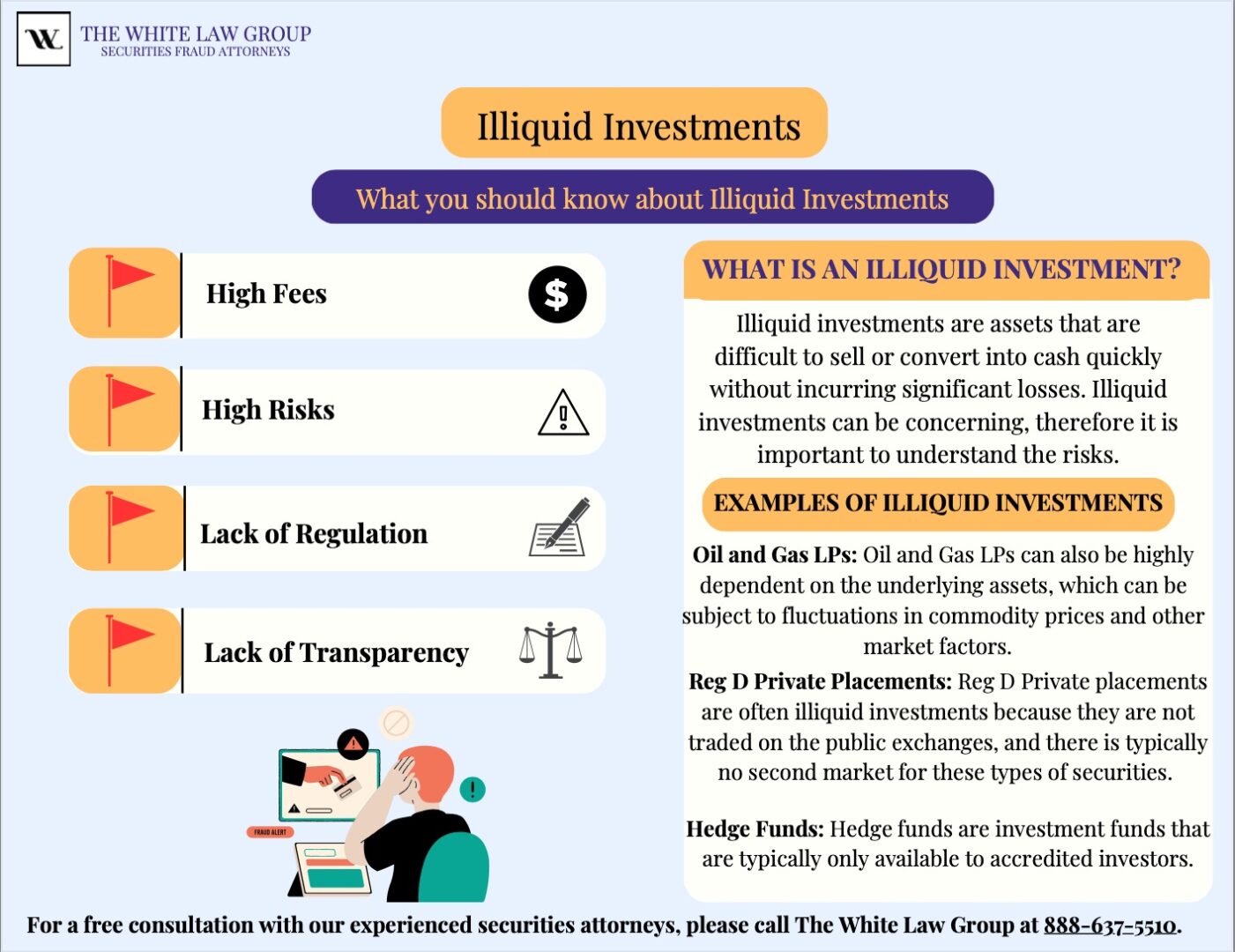
Illiquid investments are assets that cannot be easily sold or converted into cash without significant delay or loss of value. Unlike publicly traded stocks or bonds, these investments often lack an active secondary market, making it difficult for investors to exit when they need access to their money.
Because of these limitations, illiquid investments are commonly associated with:
- Long holding periods
- Limited redemption options
- Higher fees and complexity
- Increased risk of loss
For many retail investors—especially those nearing retirement—these products may be unsuitable if liquidity needs were not properly considered.
Common Examples of Illiquid Investments
Many illiquid investments fall under the broader category of complex or alternative investments. Common examples include:
Private Placements (Reg D Offerings)
These securities are not registered with regulators and are typically sold to accredited investors. They are not publicly traded and often lack any resale market.
Non-Traded REITs
Real estate investment trusts that are not listed on an exchange. Investors may face multi-year lock-up periods and limited redemption programs.
Non-Traded BDCs
Business Development Companies that invest in private businesses but do not trade publicly, limiting investor liquidity.
Oil and Gas Limited Partnerships
Oil and gas LPs depend heavily on commodity prices and often restrict transferability, making them difficult to sell.
Structured Notes
Structured notes are tied to market performance with limited or no secondary market.
Hedge Funds and Venture Capital
Typically available only to accredited investors, hedge funds often impose strict withdrawal restrictions and long lock-up periods.
1031 Delaware Statutory Trusts (DSTs)
DSTs allow investors to defer capital gains taxes through a 1031 exchange, but ownership interests are not freely tradable and may be locked in for years.
Tenant-in-Common (TIC) Investments
Fractional real estate ownership structures that often require finding a private buyer to exit, which can be time-consuming and costly.
Why Illiquidity Matters for Investors
Liquidity is a critical factor in any investment strategy. When an investment is illiquid, you may:
- Be unable to access your funds in an emergency
- Be forced to sell at a steep discount
- Miss opportunities to reinvest elsewhere
In many cases, investors are unaware of these restrictions until they attempt to sell.
Red Flags of Illiquid Investments
Investors should be cautious when evaluating hard-to-sell investments, particularly when the following warning signs are present:
- Lack of Transparency: Clear or overly complex disclosures
- High Fees or Commissions: Especially in private placements and non-traded products
- Limited or No Secondary Market: No clear exit strategy
- Aggressive Sales Tactics: Pressure to invest quickly
- Inadequate Risk Disclosure: Failure to explain liquidity constraints
These factors are often present in unsuitable investment recommendations.
Investment Losses? Contact us now for a free consultation!
Suitability and Broker Responsibilities
Financial advisors are required to recommend investments that are suitable based on your:
- Investment objectives
- Risk tolerance
- Time horizon
- Income and liquidity needs
Recommending illiquid investments to investors who need access to their funds—such as retirees—may constitute misconduct.
Brokerage firms must also perform due diligence on the investments they offer and fully disclose risks, including lack of liquidity.
Legal Options for Investors
If you suffered losses in an illiquid investment, you may have legal options—particularly if your advisor failed to disclose risks or recommended an unsuitable product.
A securities fraud attorney can help determine whether your losses involved:
- Unsuitable investment recommendations
- Failure to disclose liquidity risks
- Misrepresentation or omission of material facts
- Overconcentration in illiquid assets
Many of these claims are handled through FINRA arbitration, a process used to resolve disputes between investors and brokerage firms.
What Is FINRA Arbitration?
FINRA arbitration is a private dispute resolution process overseen by the Financial Industry Regulatory Authority. It is typically faster and less costly than traditional litigation.
The process generally involves:
- Filing a claim detailing the investment losses
- Presenting evidence before an arbitrator
- Receiving a binding decision or settlement
If successful, investors may recover a portion of their losses.
Frequently Asked Questions (FAQs)

Why are illiquid investments considered risky?
Because investors cannot easily sell them, they may be forced to hold through market downturns or accept significant losses to exit.
Are illiquid investments ever appropriate?
They may be suitable for high-net-worth or accredited investors with long time horizons and no immediate liquidity needs—but not for all investors.
What should I do before investing in an illiquid asset?
Carefully review offering documents, understand lock-up periods, and ask how and when you can sell the investment.
Free Consultation with a Securities Fraud Attorney
If you invested in an illiquid investment and are unable to access your funds—or suffered losses—you may have a claim.
The White Law Group represents investors nationwide in FINRA arbitration claims involving unsuitable investments, private placements, non-traded REITs, and other complex products.
Contact us today for a free consultation to discuss your legal options at 888-637-5510.